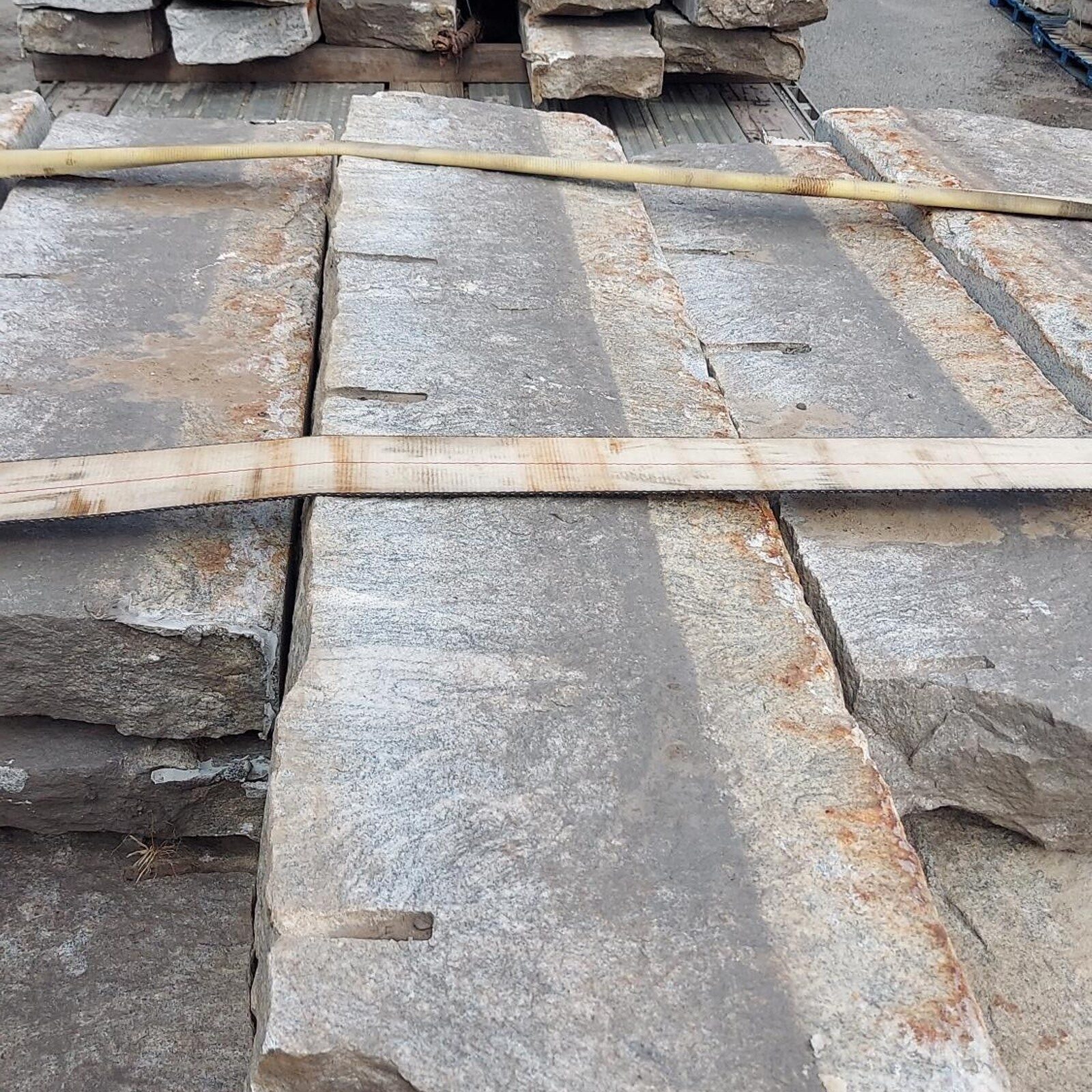
RECLAIMED CURBING

ANTIQUE CURBING

From Historic Streets to Your Home

Stone curbing has lined the streets of American towns and cities for well over a century, defining roadways, sidewalks, and public spaces. Cut from durable granite, bluestone, and sandstone, these curbs were cut by skilled masons to withstand generations of traffic, weather, wear.

Much of the reclaimed curbing we source today was originally installed in the late 19th and early 20th centuries, when expanding cities built lasting infrastructure from solid natural stone. Now, as roads are reconstructed and utilities updated, these historic stones are carefully removed rather than discarded, preserving their craftsmanship and age-earned character.

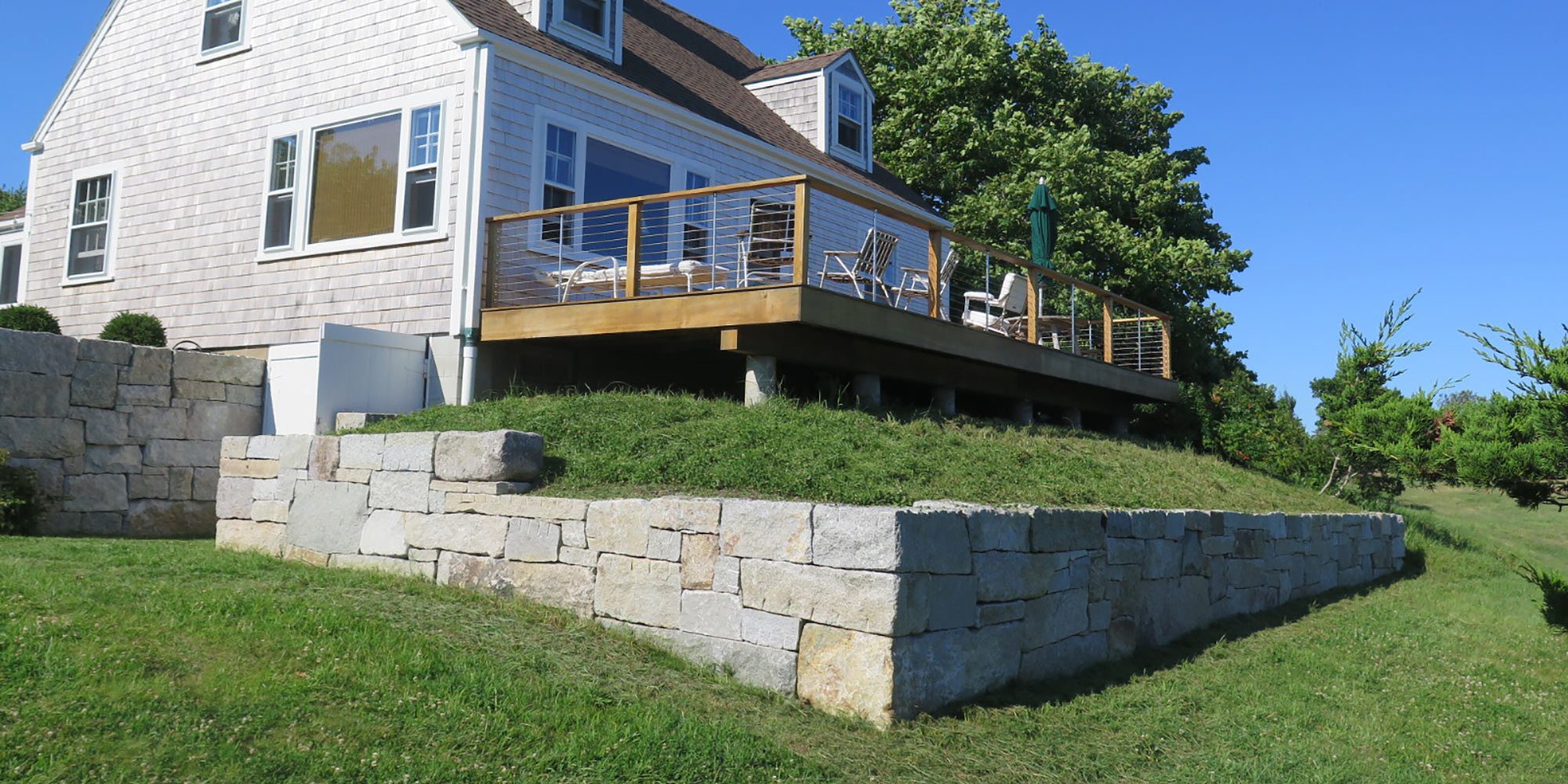
Back at our yard, we sort our reclaimed curbing by size, grade, and edging, preparing it for it’s next chapter.  In keeping with sustainable design and green building initiatives, what once defined our earliest streets now becomes rustic landscape steps, driveway borders and garden edging. 

RECLAIMED

Reclaimed Curbing Options

We regularly source three varieties of reclaimed curbing.

RECLAIMED

Granite Curbing & How We Grade it

• To help match our reclaimed curbing to our customers’ needs, we sort our material into three distinct grades: Step Grade, Paving Grade, and Curb Grade.

• While we do grade curbing derived from other stones as needed, it’s most often granite that requires grading. 

• Each grade tends to be most appropriate for particular projects, but there are grey areas.  Think of these grades as guidelines more than absolutes…

Step grade

Granite Curbing

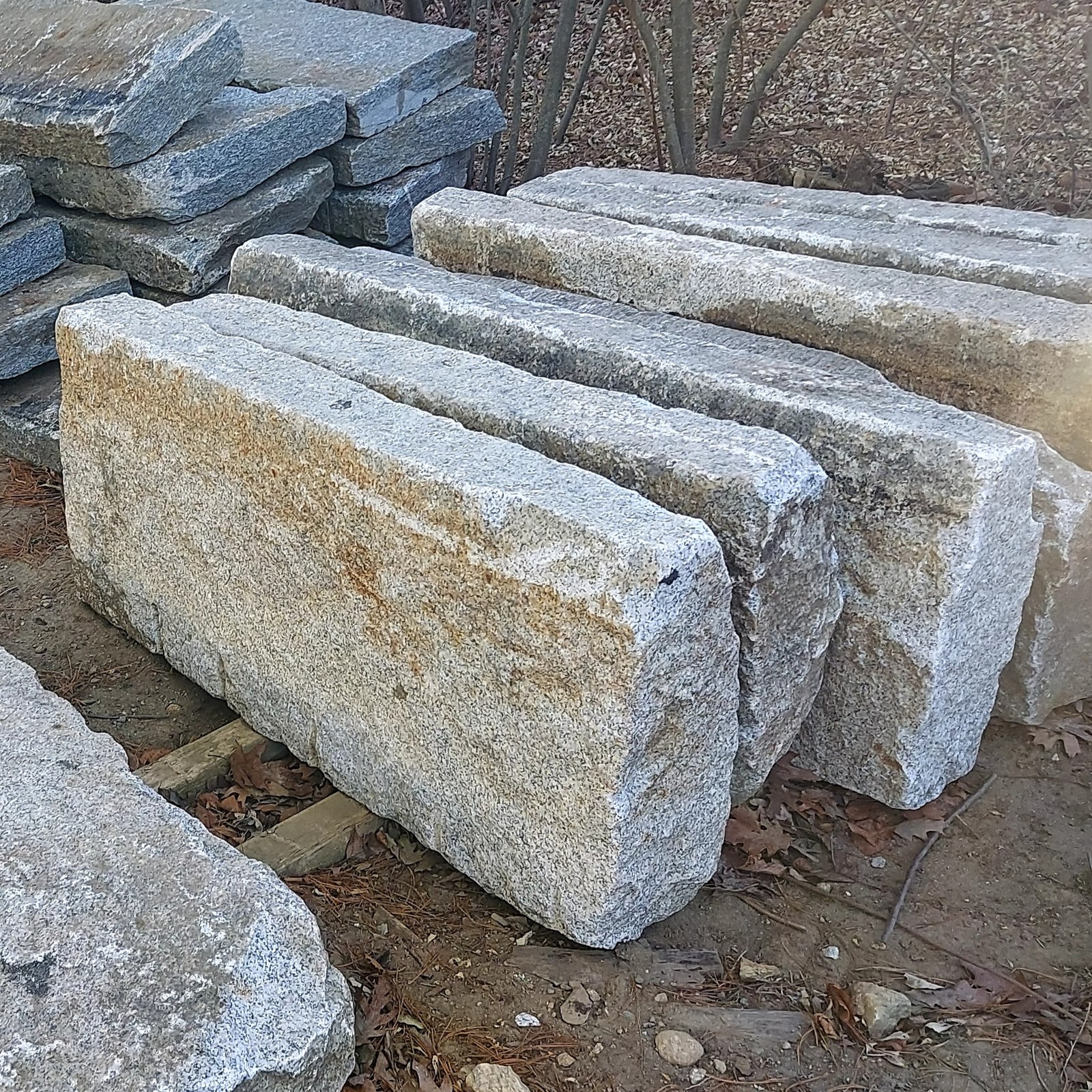
• The reclaimed curbing we categorize as step grade possesses a smooth, flat side great for landscape treads, 5-8″ thickness for risers, and beautifully worn or split edges.

• Pieces under 3′ in length are separated and categorized as “Step Grade Shorts”.

• Other common uses:  pool coping, raised garden beds, headers, and sills.

Dimensions

Approx. 3-8’L x 15-18″W x 5-8″T (shorts: <3’L)

Colors

Weathered grays to earthy tans, with traces of oxidized rust

Texture

Weathered, smooth side, with worn or split edges.

Paving Grade

Granite Curbing

• The reclaimed curbing we classify as paving grade also has a nice flat, worn side.

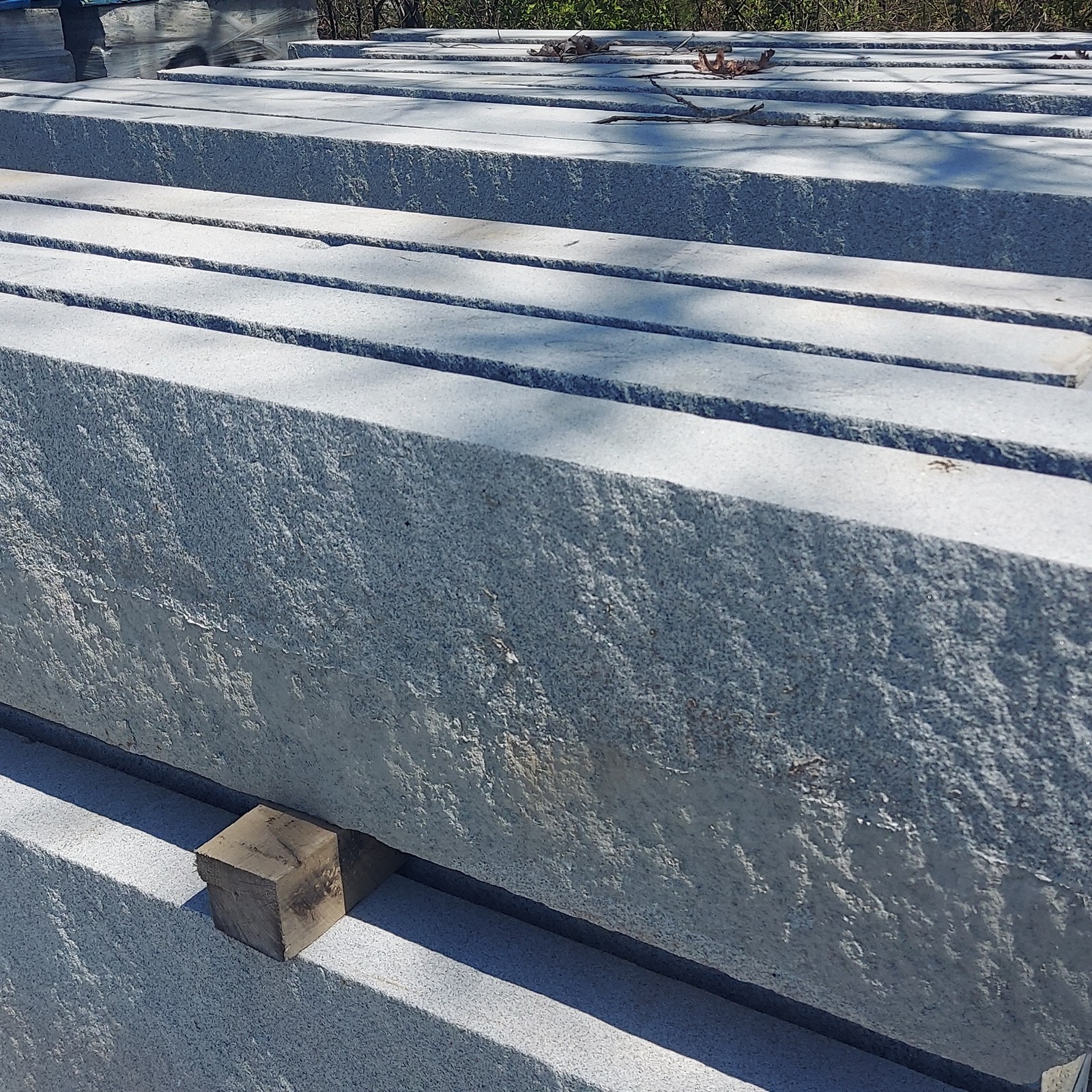
• However, it’s characterized by either one sawn and one split edge, or two sawn edges (double-sawn).

• Sawn edges are ideal for tight joints between paving pieces.

• Learn more about the different edges found with reclaimed curbing.

Dimensions

Approx. 4-8’L x 15-18”W x 5-6”T (shorts: <3’L)

Colors

Weathered grays to earthy tans, with traces of oxidized rust

Texture

Weathered, smooth side, with split/sawn or double-sawn edges

Curb Grade

Granite Curbing

• Reclaimed curbing with a beautiful worn top, but a not-so-smooth face is most often stood up and used once again as actual curb.

• Common with older, first-generation curb, the chunky, irregular face is usually buried in the ground, leaving the weathered top exposed.

• Curb grade is perfect for landscape borders and garden beds.

• It can also be used completely above-ground for a raised garden wall or firepit.

Dimensions

Approx. 3-8’L x 15-20 Tall x 5-8″ Thick (Stood-up)

Colors

Weathered grays to earthy tans, with traces of oxidized rust

Texture

Smooth, worn tops, rougher, irregular faces

SPECIALTY GRANITE CURBING

RADIUS CURBING

RADIUS CURBING

Curbing cut to fit the curvature of winding roads, on and offramps, and street corners – great for rounded garden beds, curved landscape borders, or creative design features.

JUNIOR CURBING

JUNIOR CURBING

Curbing with narrower widths (approx. 9-12″).  Edges may be split or sawn.  Often mixed in with standard width curbing to add variation to a pattern.

ROUNDED CORNER

ROUNDED CORNER

Older, chunkier curbing with a curved face. Great for rounded garden and mulch beds, landscape borders, or creative features like a firepit.

More Reclaimed Curbing Options

While granite is the most common reclaimed curbing here at Stone Farm, we also salvage other types of curbstone.  Historically, stone found in abundance in a region was often fabricated for curbing in growing nearby cities and towns.  Pennsylvania and New York bluestone, and Ohio sandstone are great examples. 

Reclaimed

Bluestone Curbing

• Bluestone is an excellent option for landscape steps, especially in settings which also feature bluestone paving for walkways and patios.

• As a sedimentary stone, it splits along preexisting planes, creating a consistent, flat surface ideal for steps.

• The natural clefting common to bluestone creates an great aesthetic, while also giving steps texture.

• Softer than granite, bluestone curbing reveals  beautiful worn edges, achieved over less time.

• It’s consistency makes working with bluestone curbing less labor-intensive, as a series of steps, or stood up as for borders.

Dimensions

Approx. 2-8’L x 14-18”W x 3-5″T

Colors

Blueish-greys, occasional traces of lilac, pale green, or silver.

Texture

Flat, with natural clefting.

Reclaimed

Sandstone Curbing

• Like bluestone, sandstone is a great choice for landscape steps, particularly as a compliment to sandstone-paved patios.

• As a sedimentary stone, it tends to split, or cleave, along preexisting bedding planes, creating nice flat surfaces perfect for steps.

• The natural clefting and grooves found on the sandstone curb face provide welcome texture to stone steps.

• Reclaimed sandstone curbing is equally effective when stood up and used for borders, beds and and edging.

Dimensions

Approx. 2-8’L x 16-18”W x 4-6″T

Colors

Buff, tan, beige

Texture

Flat, with natural clefting and grooving

LOOKING FOR AN EDGE

HOW A CURB WAS CUT MAKES A DIFFERENCE

Over time, the methods used by masons to cut granite into curbing evolved.  The results of that evolution are on display in the reclaimed curbing you’ll find in our yard. 

Split Edges

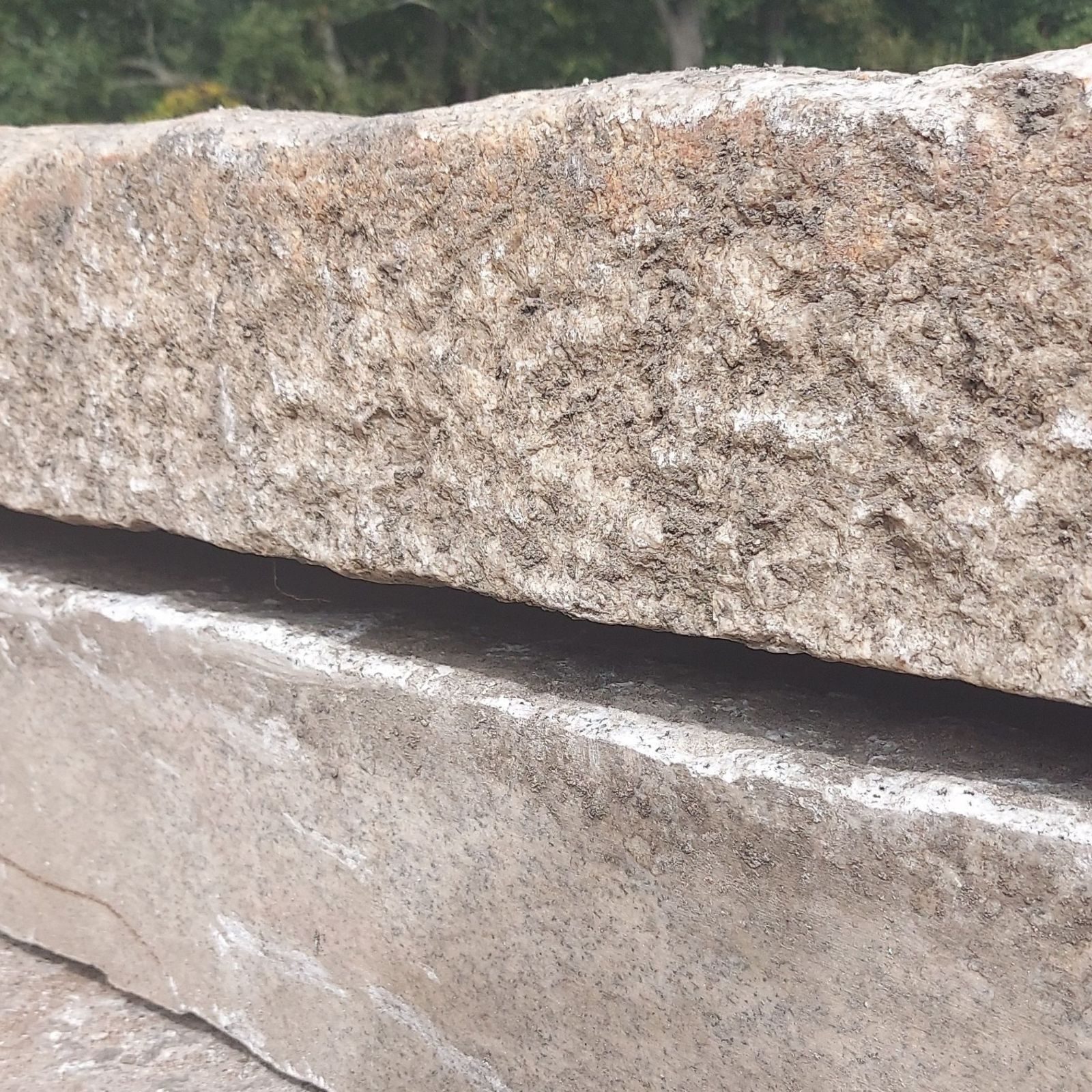
Splitting granite with plugs, shims and wedges resulted in natural, textured edges featuring spaced semicircular grooves where the plugs were inserted. These pieces are usually older, and their more primitive aesthetic is a great match for rustic designs.

Sawn Edges

As saws became more powerful and portable, and their blades sharper and consistent, masons turned to them for cutting granite.  This produced edges which are flatter, smoother and more uniform.  

Helpful Tip: If a piece of reclaimed curbing is referred to as split/sawn, one of its edges was created by splitting and the other by sawing.  If a saw was used for both edges, we describe it as double-sawn.

reclaimed-curbing-split-sawn-comparison

TOUR THE YARD

WATCH A QUICK PRIMER ON OUR RECLAIMED CURBING

If you can’t visit the Stone Farm yard to check out our reclaimed curbing in person, watching this video is definitely the next best thing.  In 2.5 minutes, Nick covers everything you need to know to start choosing the right material for your project.

WHY USE

RECLAIMED CURBING VS. NEWLY FABRICATED STONE

Incorporating antique reclaimed curbing into your landscape design provides several advantages over modern, mass-produced material:

• Time and the elements produce worn faces and edges which can’t be replicated.

• Similarly – over time -these stones develop natural color variations and patinas unique to their environment.

• The methods of stone splitting from years past are often found on reclaimed curbing.  Split edges and drill marks reveal character and authenticity.

• Too often, curbing removed from roadways ends up in landfills or a stone pulverizer.  Repurposing it eliminates the resources and energy required to discard it, as well as to produce new material.

Old New

DON'T FORGET TO

Check Out Our Blog

reclaimed wall block
Landscape Stones

Building Bests: Reclaimed Granite Wall

Reclaimed Granite Wall Block Granite was the first industrial strength building material used in America.  Throughout New England, large pieces ...
Read More →

See What Our Clients Say

Testimonials

google-reviews

Fequently Asked Questions

FAQS

WHY CHOOSE A SPLIT EDGE VS. A SAWN EDGE?
  • Sawn edges are great when you’re using reclaimed curbing for paving, and you want tight, consistent joints between your pavers.  Sawn edges produce straight, clean lines. 

  • Split edges are ideal for rustic designs where the stone’s history is part of the desired aesthetic.

  • With both split and sawn curbing, time and weather can eventually produce worn, natural edges perfect for any project where they will be exposed.

CAN RECLAIMED CURBING BE CUT TO A THINNER DEPTH?

Yes – it is possible to cut curbing to a thinner depth, so long as there is enough thickness to work with.  The process is called gauging, and is usually done by a skilled mason in a fabrication shop.  Pool coping is a common project requiring gauging curb to a thinner depth.

WHY DOES THE AVAILABILITY OF RECLAIMED CURBING FLUCTUATE SO MUCH?
  • Supply: While we’re always looking for opportunities to reclaim curbing, it’s increasingly scarce and the timing and logistics of each project directly affect how much material we salvage, and how long it takes to arrive in our yard.  
  • Demand: Because curbing is so versatile, it’s probably the most-requested material we carry.  From lintels and mantles, to borders to paving to steps – its applications seem limitless.  It’s rare that we don’t have a list of customers waiting for reclaimed curbing to arrive at Stone Farm. 

Ready to Begin Your Project?

Bring the Timeless Beauty of Reclaimed Curbing Home

Our team can help you select the perfect stones for driveways, walkways, patios, and landscape designs. Whether you’re restoring historic character or creating something truly unique, we’ll guide you every step of the way.

Ready To Get Started?

Fill Out Our Form

Ready To Get Started?

Fill Out Our Form