

If you’ve ever flown into a New York City airport, a look down on Manhattan can make it seem as if you’re circling above an island of brick. Have you ever wondered why so many buildings in Manhattan are made from brick? Or where all of that brick came from? It’s an interesting story fueled by catastrophe and ingenuity.
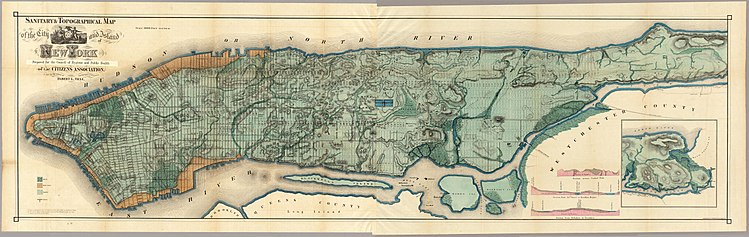
(above photo of the island of Manhattan is credit of Wikipedia)
THE RISE OF NEW YORK BRICK
The Hudson River Valley was the world capital of brick making in the late nineteenth and early twentieth centuries. Clay around the Hudson River was formed from glaciers long ago and was very plentiful. There was so much clay that brick became a go-to material for the region, especially in 1835 when brick became a mandated building resource.
That year, a great fire spread through Manhattan, burning for almost a full day and prompting laws mandating the use of fire-proof materials when building. Out of this, the New York brick industry began to boom. Another fire in 1845 destroyed more of the city’s older wooden structures, significantly increasing the number of buildings in New York City that had to use fire proof material such as New York brick. By 1866, regulations were extended throughout the entire city with 50 acres, or 670 buildings mandated to use fire proof materials like brick and stone.
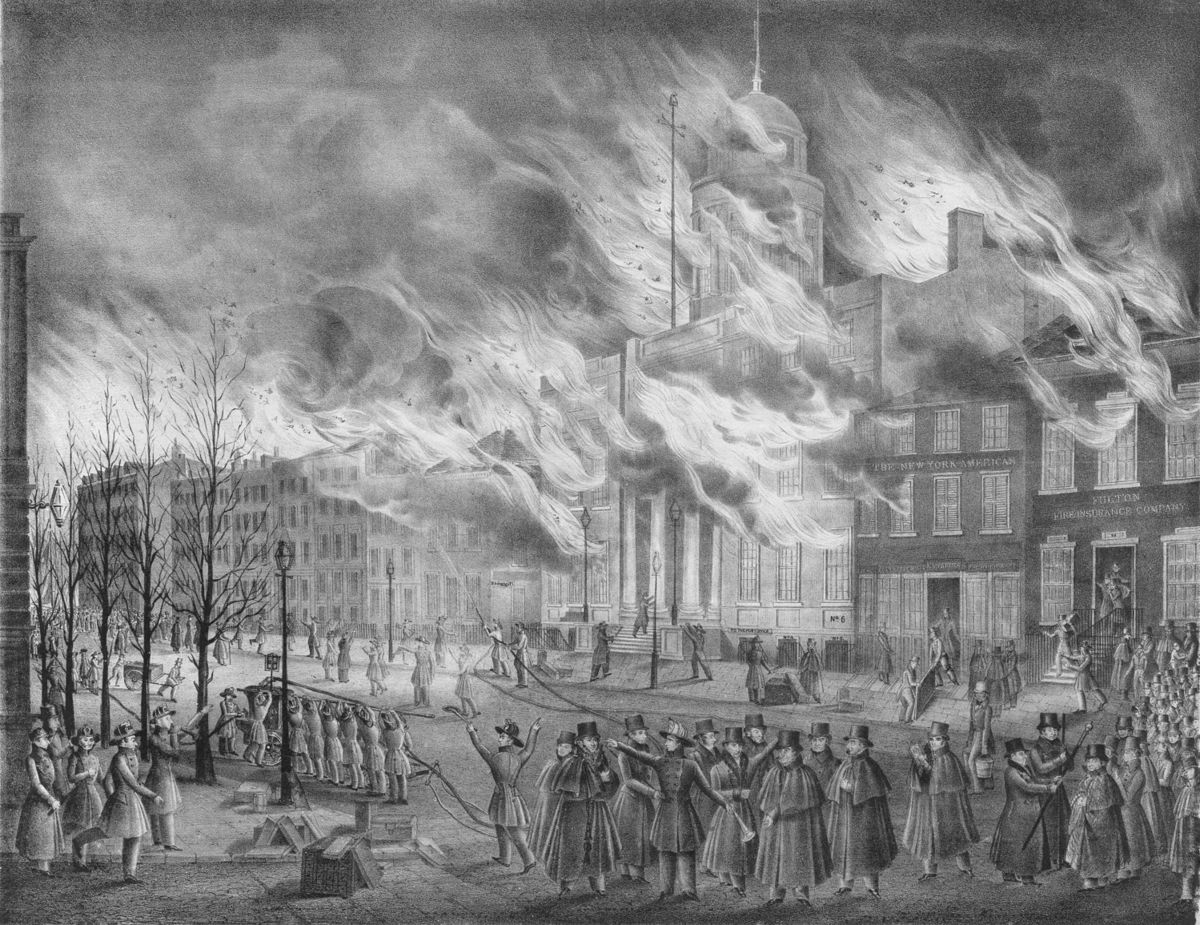
(above photo of the great fire in New York City is credit of Wikipedia)
MEETING THE NEEDS OF A GROWING METROPOLIS
The Hudson Valley-based New York brick industry boomed even further as the population in Manhattan increased and so did the need for brick buildings to house people. It housed more brick yards than any other county in New York state. In 1870, Manhattan’s population was less than one million. By 1920, the population was at 5.6 million. In 1900, there were over 100,000 brick buildings on the island of Manhattan. The standard New York building of that century would use roughly 400,000 bricks. From houses, to schools, government to office buildings, all were constructed of brick.
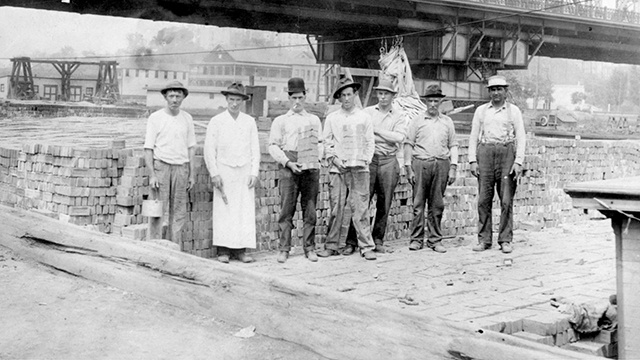
(above photo of brickmakers is credit of wtbh.org)
Just a little math, and you realize that tens of millions of bricks built Manhattan. Not only was that a lot of bricks, it also required a lot of labor. At one point 1 out of every 8 people was employed by the brick industry. It was a pivotal period in New York’s construction story, and the reason why brick’s influence is still felt so strongly across the Big Apple.
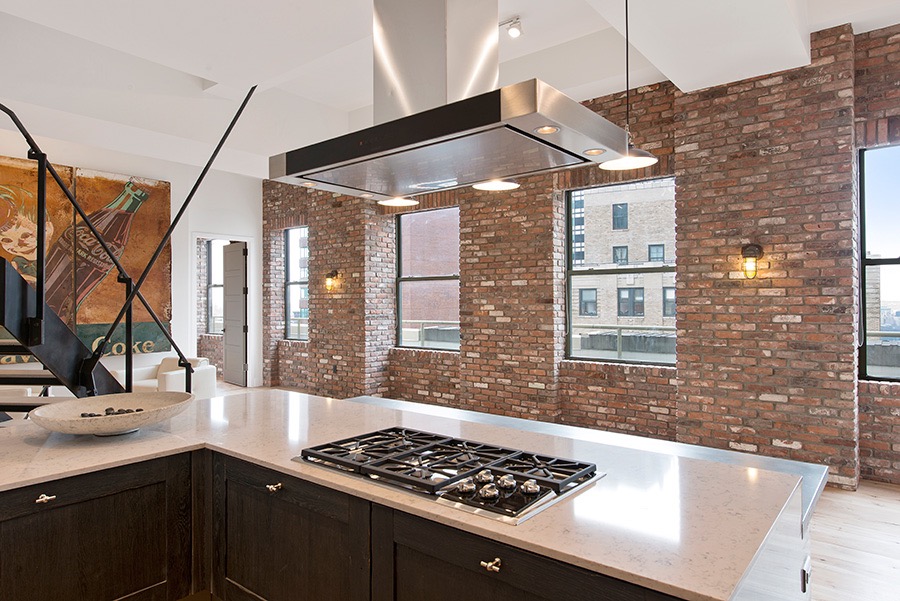
Today, brick is still prevalent in Manhattan, but often in the form of a reclaimed thin brick veneer. When the penthouse at 99 John St. was renovated, the architect Newman Design envisioned a modern space, but incorporated steel and reclaimed brick veneer to tie in the roots of Manhattan.
Similarly, for the construction of the New York City Bagel and Coffee House in Astoria, Queens, antique brick tile was the material of choice. Bagels and bricks – two great New York traditions – have made the eatery a welcome addition to the neighborhood.

New York City Bagel & Coffee House-Astoria, Queens
When historic brick buildings throughout New York and New England face demolition, Stone Farm works with the companies commissioned to do the work to salvage as much of the brick as possible. If you’re interested in incorporating authentic, historic brick into your project, Stone Farm would love to help you achieve your vision.
Learn more about how our reclaimed brick is repurposed as Brick Floor Tile, and brick wall veneer. Whether you want to add a brick accent wall to your living room or bring vintage character to your kitchen with brick floor tiles, Stone Farm can help.